
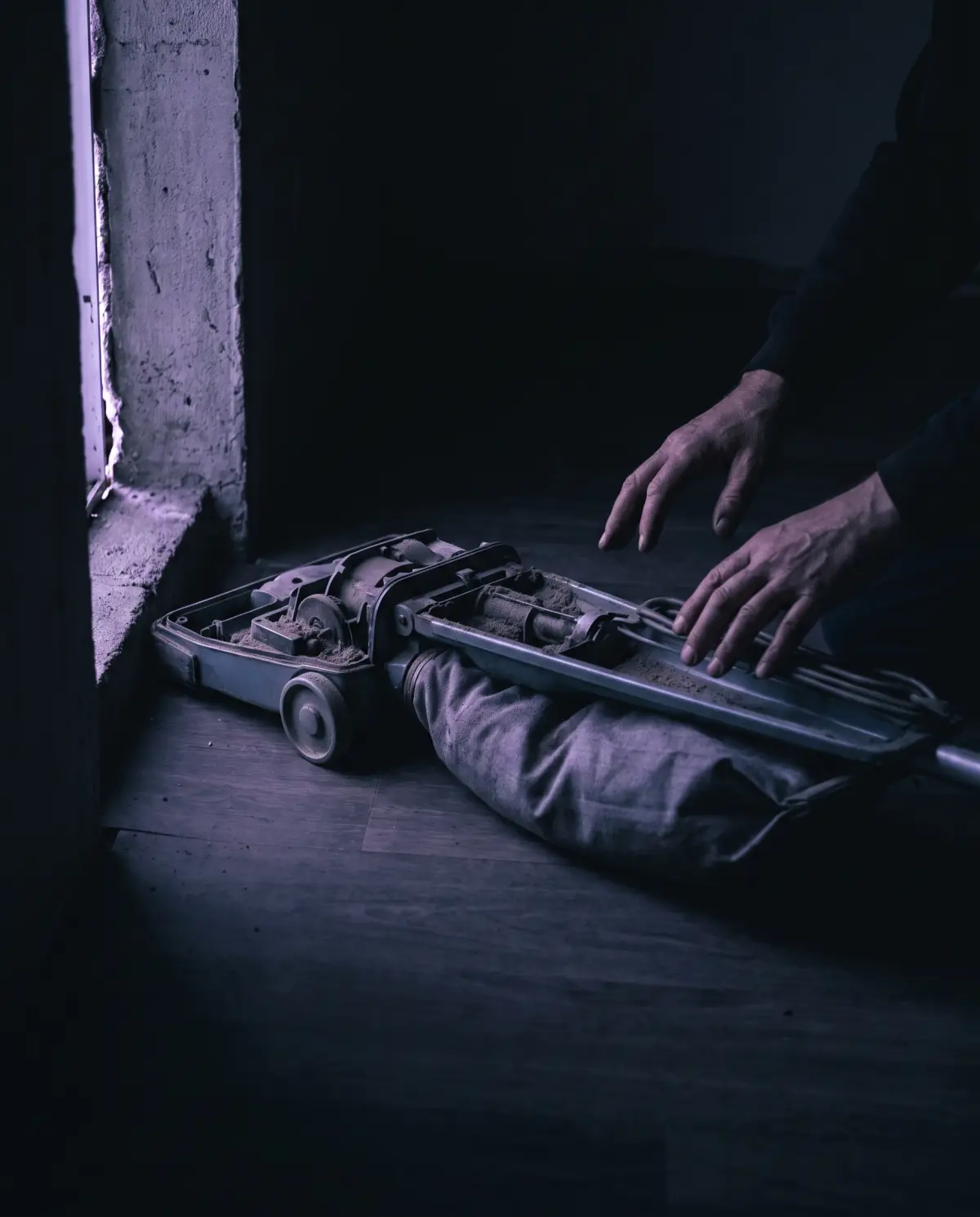
In the 1970s, James Dyson bought a Hoover Junior that lost suction when its dust bag became clogged. He investigated cyclone technology used by sawmills and began testing whether it could work inside a household vacuum cleaner. He built a large cyclone model, connected a cardboard version to a Hoover with the bag removed, and continued developing prototypes in a shed behind his house. Dyson developed 5,127 prototype designs, while he personally described the process as 5,127 attempts and said there were 5,126 failures before the solution. Major manufacturers rejected the idea, so Dyson licensed the design to Japanese company Apex Ltd. The G-Force cleaner launched in Japan in 1983 and sold for the equivalent of US$2,000. Using income from the Japanese licence, Dyson founded Dyson Ltd in 1991 and later entered the market under his own name. The company expanded beyond vacuum cleaners, survived failed products and a cancelled electric vehicle project, and is now owned 100% by Dyson and the Dyson family.
The path
- 1947James Dyson was born on 2 May 1947 in Cromer, Norfolk, England.
- 1965-1966Dyson spent a year at the Byam Shaw School of Art.
- 1966-1970Dyson studied furniture and interior design at the Royal College of Art before moving into product design.
- Early 1970sDyson helped design the Sea Truck and developed the Ballbarrow.
- 1979-1984Dyson developed 5,127 prototype designs for the cyclonic vacuum.
- 1983Dyson launched the G-Force cleaner through catalogue sales in Japan.
- 1986A reworked version of the Cyclon, called G-Force, went into production and was sold in Japan.
- 1991Using income from the Japanese licence, Dyson set up Dyson Appliances Limited, registered as Barleta Limited.
- 1993Dyson opened a production facility in Chippenham, Wiltshire, and the first vacuum built there was completed on 1 July.
- 2002The company transferred vacuum cleaner production from Malmesbury to Malaysia.
- 2011-2017Dyson served as Provost of the Royal College of Art from August 2011 to July 2017.
- 2013Dyson launched a US$360 million plant in Tuas, Singapore.
- 2017Dyson announced plans to produce an electric vehicle and said it would invest £2 billion of his own money.
- 2019Dyson moved its company headquarters from the United Kingdom to Singapore.
- 2019Dyson cancelled its electric car project because it was not commercially viable.
- 2022Dyson announced a further S$1.5 billion investment in Singapore.
- 2025The material lists Dyson Ltd revenue of £6.13 billion and operating income of £600 million.
The numbers and where they come from
Every figure comes with the source it was taken from.
„Founded in 1991 by James Dyson in Malmesbury"
„Dyson Limited is a British-Singaporean multinational technology company."
„using cyclonic separation to create a vacuum cleaner"
„the dust bag pores kept becoming clogged with dust, which reduced suction."
„I made about 5,127 prototypes of my vacuum"
„There were 5,126 failures."
„Dyson launched the "G-Force" cleaner in 1983."
„the G-Force sold for the equivalent of $2,000"
„Dyson licensed the technology in North America from 1986 to 2001 to Fantom Technologies"
„the High Court ruled that Hoover had deliberately copied a fundamental part"
„Hoover agreed to pay damages of £4 million."
„designs, manufactures and sells a variety of household appliances"
„In 2019, Dyson moved its headquarters from the United Kingdom to Singapore"
„to be closer to its manufacturing and supply-chain hubs and Asian customer base."
„announced plans to produce an electric vehicle, aiming to be launched in 2020"
„investing £2 billion of his own money."
„the electric car project had been cancelled due to it not being commercially viable."
„Dyson announced that it would be investing a further S$1.5 billion in Singapore."
„Operating income £600 million (2025)"
„Owner James Dyson & Dyson Family (100%)"
„market research showed that people would not be happy with a transparent container"
„this turned out to be a popular and enduring feature"
„In 2017, he launched the Dyson Institute of Engineering and Technology."
„But I learned from each one. That's how I came up with a solution."
What to take from it
- Start with a specific problem you have seen yourself.
- Test the mechanism before trying to sell the story around it.
- Rejection can force a different route to market, but it does not prove the idea will work.
- A long prototype history is evidence of iteration, not a guarantee of success.
- A product decision can go against market research when the reason is clear and the result can be tested.
Where things stand today
The material describes James Dyson as chairman of Dyson Ltd and identifies Dyson and the Dyson family as owning 100% of the company. Dyson Ltd is headquartered at St James Power Station in Singapore and is described as having 14,000 employees in 2022.
The full guide as a PDF
Every step, the numbers with their sources, the mistakes and the lessons — as a document to keep.
Guide als PDF ladenSources
All the material this story rests on.
Transparency: every figure in this article was checked against its original source. Anything stated only by the person described is labelled as self-reported. Claims that could not be verified do not appear here at all.